
Senior Pet Care · Long-Haired Cats
The Real Reason Your Cat Keeps Hacking Up Hairballs — Even If You Brush Her Every Single Day
I brushed Biscuit faithfully every morning for three years. So why was she still coughing up hairballs on my pillow at 3 a.m.? The answer turned out to be hiding in plain sight — under her fur.
It was the sound that got me first. That deep, awful hack… hack… haaack in the dark. I shot up in bed at 3 a.m., heart pounding, certain something was terribly wrong with my Biscuit — a fluffy 9-year-old ragdoll who follows me from room to room like a little shadow.
I found her on my pillow, shoulders heaving, bringing up a hairball the size of my thumb. And here's the part that broke my heart: I had brushed her that very morning. Like I did every morning. Like I'd done for years.
If you've ever stood in your kitchen in your slippers, stepped in a cold wet hairball, and thought "I'm doing everything right — why is this still happening?" — then I wrote this for you. Because it turns out I wasn't failing my cat. I just had the wrong idea about what brushing actually does.
First, let's be honestYou're not lazy. You've been trying everything.
I want to say this clearly, because I needed to hear it: the hairballs are not because you don't care. If anything, the people I know with the worst hairball problems are the ones brushing the most. We're the devoted ones. We're the ones who feel guilty.
Over the years I bought every "solution" the pet aisle offered. Maybe your drawer looks like mine did:
Felt nice. Biscuit liked it. But it just petted the loose fur on top around — it never pulled much out.
Grabbed a surprising amount of fluff. I thought I'd cracked it… until the hairballs came right back.
$40. Beautiful handle. Same result. By now I figured hairballs were just something cats do.
Here's the thing — every one of those tools does pull out fur. You can see it in the brush. (I eventually lined them all up and ranked the five most popular de-shedders here, if you want to see how they compare.) So why didn't any of it stop the hacking? That question nagged at me until a retired vet tech at my book club explained something I'd never heard in 22 years of owning cats.
"Pam," she said, "you're brushing the coat she shows you. The hairballs come from the coat she's hiding."
The part nobody told meYour cat has two coats. Your brush only touches one.
A long-haired cat doesn't have one layer of fur — she has two, and they could not be more different:
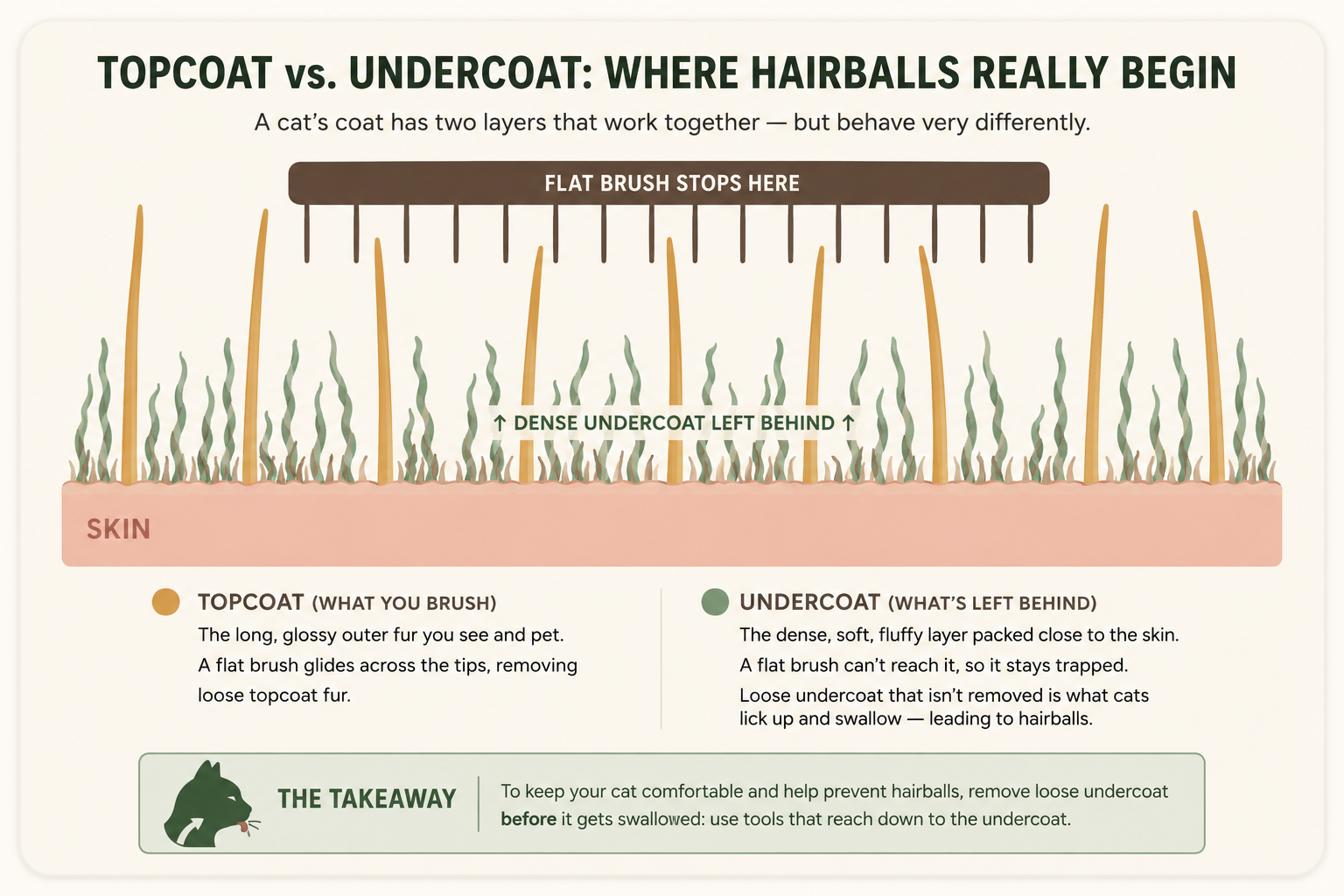
Read that again, because it changed everything for me. The hairball on my pillow wasn't random. It wasn't "just what cats do." It was the exact undercoat my brush kept skipping — relocated from her skin to her stomach to my pillowcase.
It wasn't my brushing that was failing. It was that the brush was built to miss the very fur that causes hairballs.
And the other heartbreakThe same trapped undercoat is what forms painful mats
There's a second cruelty to that hidden layer. As the loose undercoat tangles against the skin, it knots into mats — those tight, felted clumps behind the ears, under the legs, along the belly.
And you know what happens next. You try to brush the mat out with that same flat brush, it snags, it pulls — and your cat lets out that little cry and bolts. I can't tell you how many times I apologized to Biscuit out loud. I hated hurting the one creature who trusts me most.
A flat brush can't get under a mat to release it. It can only drag across the top and tug at her skin. The mat doesn't need more force. It needs the right tooth in the right place.
What finally workedOne comb. Two sides. Built for the layer the others miss.
My book-club friend slid a simple little tool across the table. No fancy handle. No $40 price tag. Just a two-sided de-shedding rake — and once she explained it, I understood why everything else had failed.
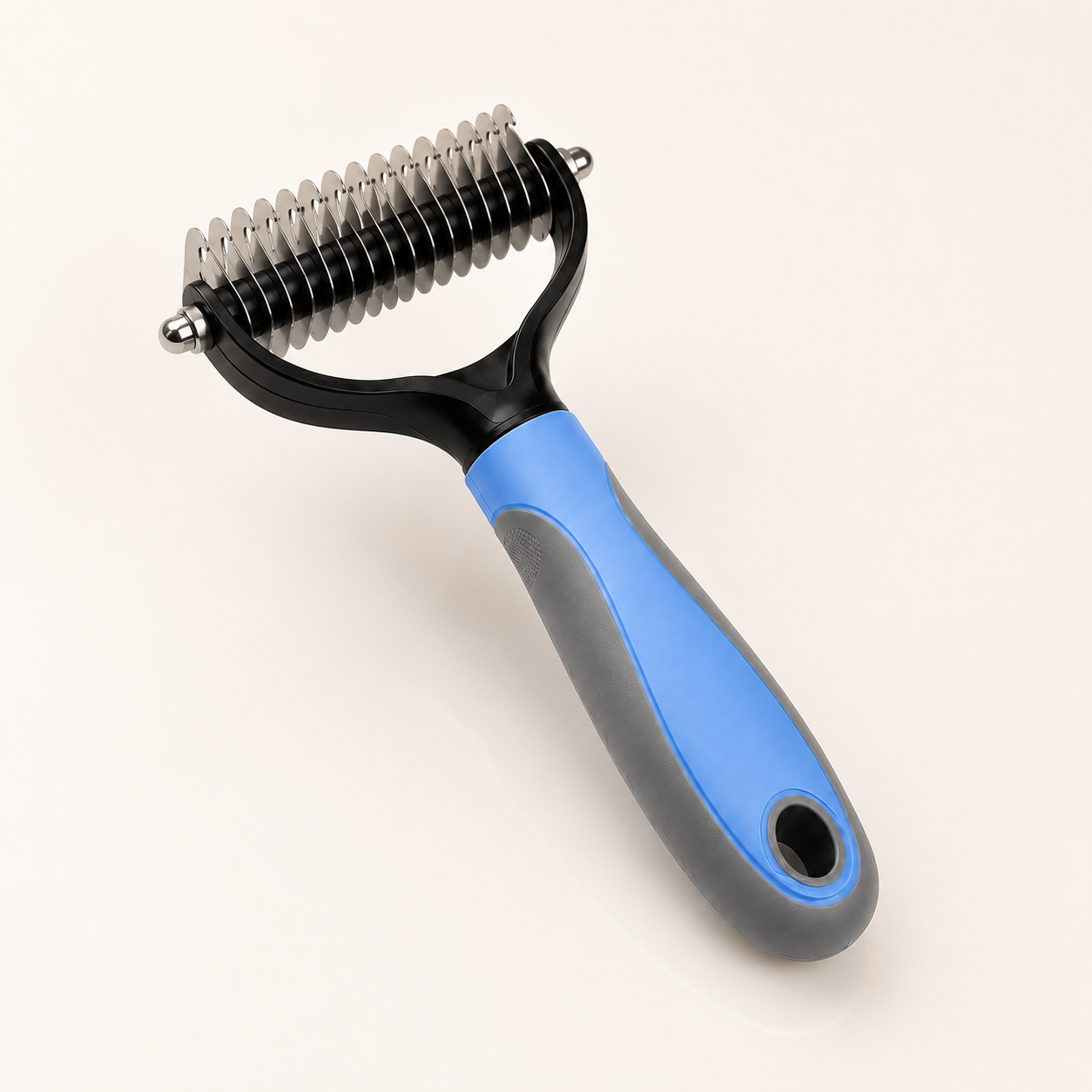
The Tidy Tails 2-in-1 De-Shedding Rake
One side combs the loose undercoat out. The other works knots apart — without the tug-of-war.
The row of densely-set blades sinks past the topcoat and combs out the loose undercoat near the skin — the exact fur she'd otherwise swallow.
The wider, stronger blades slice through small mats and tangles, instead of snagging and dragging at them the way a flat brush does.
The blades are shaped to glide against the skin while they catch the fur, so with a light, easy hand it works through the coat rather than yanking at it. Biscuit actually leans into it now.
What changed at my houseFrom 3–4 hairballs a week to one in two months
I'm not going to promise you a miracle, because I didn't get one. What I got was quiet. The slow, ordinary kind of relief you almost don't notice until you realize it's been weeks since the last 3 a.m. scare.
The first time I used the de-shedding side, I genuinely gasped at how much soft fluff came off — fur I had no idea was even there, after I'd "finished" brushing with my old tool. That was the undercoat. That was the hairball, in my hand instead of her stomach.
And the mats? The dematting side worked through a knot behind her ear that I'd been dreading for a week. No yanking. No crying. No bolting. She blinked at me, stretched, and leaned into it. I actually teared up a little. After all those apologies, I was finally helping her without hurting her.
"Sharon from my book club told me about this and I was skeptical — I'd bought every brush there is. But the amount of undercoat it pulls is unreal, and my Muffin used to hate grooming. Now she waits by the comb. Hairballs down to almost nothing."
"I'm 68 and my Persian's mats used to mean a stressful, expensive groomer trip. The dematting side gets the small ones out at home, gently. He purrs through it now. I bought a second one for my daughter's cat."
The question I had too"But what if my cat just hates it?"
This was my worry exactly. Biscuit had learned to run when she saw a brush, and I didn't want one more tool she'd hide from. Here's the honest truth: cats dislike grooming when it pulls. Take away the pulling and most of them stop fighting it — many start asking for it.
But "most" isn't "all," and I'd never tell you your cat is guaranteed to love it. So here's what made me comfortable trying: if Biscuit had hated it, I could send it back and lose nothing. That guarantee is the only reason I took the leap — and I'm so glad I did.